Showing posts with label miniatures. Show all posts

Friday, October 7, 2011

After-action report: Tomorrow's War


After a supply ship was brought down by Neo-Soviet recon elements on the desert world Fornacis V, the decision was made to send in a retrieval squad from Markham's Skybolts, a well-known mercenary company operating dirtside on the planet. The pilot bailed out and made landfall, offering vague details about the Neo-Soviet platoon that was mustering in the dry woodlands around his position. He sought refuge in a nearby colony hab-unit and waited for rescue.

My local club gathered this week to try out Tomorrow's War, the highly anticipated "hard" sci-fi ruleset from Ambush Alley Games and Osprey Publishing. We had been hearing about this game for the better part of a year, as it debuted a while back as an add-on to an existing Ambush Alley title. Now it's being released as a standalone hardcover book — a gorgeous tome, I should add, replete with tons of color photos and example illustrations.

The folks at Osprey were kind enough to send me an advance copy to read and review. What follows here is a battle report of the Skybolts' attempt to extract their pilot from a Neo-Soviet ambush. I'll offer a more substantive review of Tomorrow's War in a future post.

For this game, I ran a scenario straight out of the book. Four players showed up, so I opted not to run a squad and instead perched on a stool spewing rules minutiae for the entire two-hour game.

The photo at the top of this post shows the battlefield at the outset of the game. The three 4-man Skybolt fireteams entered at the bottom of the picture and had to reach the building, grab the pilot and exit the map by Turn 8. Four Neo-Soviet squads were waiting in ambush in the scrub woods surrounding the building.

The first two turns saw the Skybolts players rush their mercenary squads forward, using the rapid move ability to grab some cover on the flanks.

The Neo-Soviet players responded by moving a few squads out of ambush and advancing forward, prompting a couple firefights. In Tomorrow's War, a unit that is being fired on can choose to react by either returning fire or moving away. Moreover, a troop quality check made at the outset of that exchange means that sometimes the targeted squad is able to shoot first, inflicting casualties on the enemy squad before it has a chance to shoot.

Lots of these little firefights — called 'rounds of fire' in the rulebook — erupted as the various fireteams jockeyed for position on the tabletop. The Neo-Soviet troops were low quality but numerically superior. The Skybolt mercenary soldiers were high quality, but few in number. Both sides inflicted a few casualties before the Skybolts managed to charge into the building in the center of the table, quickly locating the missing pilot. From there, they used the comparative safety of the building to pour fire into a Neo-Soviet squad, all but wiping them out.

By this point we were on turn 5, and the mercenary players knew they didn't have much time to dither. They hustled the pilot back toward their edge of the table as fast as possible — which wasn't very fast, considering that squads escorting dependents (the pilot in this case) can't use the rapid move ability! Seeing this, the Neo-Soviet players charged their squads out of cover and began a full-on pursuit across the windswept battlefield. Here they go!

The Skybolt squad in the lower right corner has been 'wiped out' in game terms. The soldiers aren't dead, but there isn't a healthy trooper available to make a first aid check, so the unit stays tipped over until its casualties are assessed. As it happened, this squad wasn't reached by a healthy trooper before the end of the game, so the tipped-over models counted as captured soldiers for the scenario. This particular victory condition put the Neo-Soviet players over the top when we tallied up points at the end.

Anyway, the Skybolts slogged through a fearsome hail of gunfire as the Neo-Soviets enveloped them with superior numbers. Luckily Skybolt one squad that had spent pretty much the entire game on overwatch proved very useful at disrupting the Neo-Soviets advance. With just 3 combat effective soldiers, this little fireteam held up at least twice their number of lower quality Neo-Soviet troopers. This sacrifice allowed the main squad to escape with the pilot at the end of Turn 8. Here's the squad (with pilot) as they make their exit off the battlefield. The rearguard fireteam is just visible in the distance; those soldiers were honored posthumously for their dedication to the mission.

So, the Skybolts won, right? They accomplished their mission? Well, they did, but the Neo-Soviet players also had their own mission objectives. Chief among those were "inflict casualties" and "capture wounded," both of which they did in spades. The Neo-Soviets were able to squeak out a victory based on the specific parameters of this scenario. A marginal victory at best, as one of the Skybolt players pointed out.

Here's a picture of the final positions of the units on Turn 8. The Neo-Soviet players' squads are badly mauled but still active; the Skybolts also suffered proportionate casualties.


Overall I was very pleased with how this scenario turned out. Tomorrow's War doesn't have a point system, which makes it extremely important to craft well-balanced scenarios. This game was an example of that. The forces were evenly matched even though the Neo-Soviet player put about twice as many miniatures on the table as the Skybolts player. The mechanics supported this as well, with the Skybolts using their improved troop quality and weaponry to counter the numerical superiority of the Neo-Soviets.

The victory conditions meant that although the Neo-Soviet players were rather demoralized to watch their troopers die en masse for most of the game, they were still able to accomplish their objectives and win the day. This was a nice departure from so many games, where if you lose a big pile of figures you're pretty much guaranteed to lose the game as a result.

We made a few rules blunders here and there, of course, but overall the game played out quite well. I've played in horribly one-sided scenario games that were just no fun to play. This game moved along briskly and victory wasn't assured until the very last turn of the game! It was "a real nail-biter" as one player pointed out at the start of Turn 8. This game will likely become the go-to squad sci-fi game for our club.


Tuesday, September 20, 2011

After action report: 5150 Star Army

A large group turned out last week to try out 5150: Star Army, the latest revamped release from Two Hour Wargames. Our club had tried out 5150 (previous edition) earlier this year with mixed results, mostly owing to the fact that we weren't sure if we were playing the game correctly.

This go-round was much, much cleaner. We organized two side-by-side games on Karl's excellent desert wastelands table. I refereed (and played in) a 2-vs-1 game pitting two Free Company mercenary commanders against a single Star Army commander.

As is the spirit of 5150, we eyeballed the opposing forces and tried to come up with balanced armies. The two Free Company players each brought 15-20 figures to the table, organized in two squads each with one or two support weapons per squad. The Star Army player brought three squads with support. As this was a demo game meant to show off the rules engine, we didn't bother with a scenario. All future games will use scenarios, though, because it's more fun that way!

Anyway, the game played smoothly. As the referee, I had no problem at all leading the players through the various reaction tests as they maneuvered their guys around the table. The open-ended nature of the reactions meant that some turns were quite brisk while others turned into epic back-and-forth firefights. This was exciting for me, but the other Free Company player didn't seem to enjoy it as much.

Here's a photo of how our game shaped up. The Free Company squads are on the left side of the photo, approaching under the cover of some boulders and trees. The Star Army, on the right, is scaling the rocky hill in the center of the table.

They seized the high ground early on, which allowed the Star Army support weapons (rocket launcher and grenade launcher, mostly) to rain death down on our approaching troops. We got to learn A LOT about the outgunned rule while fleeing from these weapons. At one point two opposing squads were perched on opposite sides of the hilltop lobbing grenades at each other!

The game itself was a glorious meatgrinder, which was of course the whole idea in the first place. Nothing helps you learn a game like dishing out (and absorbing) heavy casualties.

In this pic, the Star Army player presses the attack with his badly mauled squads.

By the end of the game we had a good grasp of the rules. What's more, I had learned quite a bit about the differences between the various army reaction tables. Star Army is much more apt to shoot accurately under pressure, while Free Company is liable to panic and snap-fire an entire magazine.

Friday, August 26, 2011

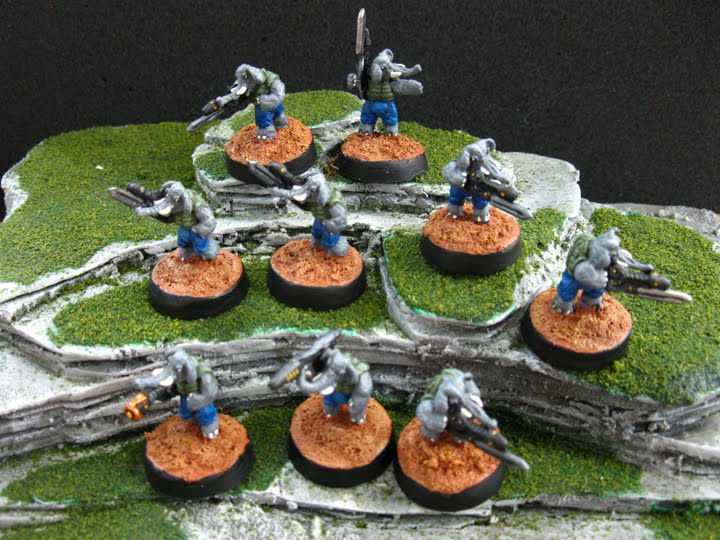
Fully painted: Pachydon sci-fi elephant troopers


Back at Little Wars I picked up a pack of Pachydons, which are these bipedal elephant-men with laser rifles, part of the Blasted Planets sci-fi line. Yes, they are awesome, and completely zany as well. The rest of the line includes gator-men, moose-men and various other genetically modified critters, all armed with the latest 22nd century battle equipment.

These dudes are also a bit small — they are true 25mm figures, so they're a bit runty next to my heroic 28mm stuff. Luckily, all it takes is some imagination to figure out a reason why they're short... obviously, they're from a high-gravity world!


I imagine these guys will hit the field as a mercenary company hired to fight on myriad wartorn world...


Thursday, April 28, 2011

Auditioning for a sci-fi skirmish rule set

There's a reason my local miniatures club is called Chicago Skirmish Wargames — it's because we like collecting small, unique groups of cool miniatures rather than vast, homogeneous armies that take eons to deploy onto the table.

As a result, we've been drawn to small, skirmish-scale rulesets for various genres. We've got fantasy covered with Song of Blades & Heroes, but sci-fi has been a bit more troublesome. The club has spent the last half a year trying out many different sci-fi rulesets, with varying degrees of success and failure. What follows here are my own thoughts (not the club's! I don't speak for everyone) about the rulesets we've sampled, what works and what doesn't.

The ground rules: we were only interested in games that encouraged us to use generic, non-brand-specific miniatures. So, Necromunda (despite being an alright game) was out.

Flying Lead — Published by Ganesha Games (the folks behind Song of Blades & Heroes) this game adds another level of complexity onto its super-simple game engine. Unfortunately, this added complexity proved to be a turnoff to me. The beauty of SBH was that it required virtually no rulebook-flipping once you understood how your warband worked. Flying Lead required considerably more cross referencing, plus we needed to use little counters or tokens to mark the condition of a particular figure (prone, fallen down, etc). I don't like tokens — they clutter up the battlefield and must be removed prior to taking glorious game photos. It's also worth noting that Flying Lead isn't really a sci-fi game — it's more of a modern combat game, with assault rifles and grenades and whatnot. Trying to graft it onto a sci-fi setting might have been our first mistake.

Wastelands — This free PDF is sort of a stripped-down RPG where you assemble a squad of dudes, trick them out with all sorts of equipment and weaponry and send them into battle against each other. The game system itself is functional and decently generic, but not particularly innovative. The best part of this game is that although it's nominally a game about post-apocalyptic battles, you can easily adapt it to a variety of sci-fi settings and genres. We've played this game quite a bit over the last year or so.

5150 — Two Hour Wargames' sci-fi title is pretty well-known, and we were excited to give it a try. As expected, the game played out differently than any other system we'd yet encountered. Basically, your little guys don't always do what you want them to do, and sometimes they flat-out disobey you. It was refreshing, in a way, and of course this sort of ruleset lends itself well to solo play. My only gripe is that 5150's point system is a bit wonky — veteran players will just tell you to play scenarios, which is all well and good, but I need a starting point of some sort.

WarEngine — This is the rules engine that powered the now-defunct game ShockForce, which was first published back in the 1990s. It's a strong, generic system that's been lovingly husbanded by its original creator, Aaron Overton, over the years. It lives on now as a thriving wiki (!) and is 100% free. Of all the games we've auditioned, this one felt the most like what I was after: a true wargame experience that took me back to the halcyon days of playing 40k in high school, but presented in a fully updated, fully supported website that's easy to navigate and totally free of charge. The game itself lets you build units from the ground up using generic statistics and game effects, which really juices my imagination. Once you've got your units built, the engine also has ways to create balanced army composition lists so you can pit your forces against your opponent.

If I had a gripe, it would be that this game seems designed for slightly larger battles than we've played lately. WarEngine games don't feel like much unless you have at least 3-4 maneuver elements (squads, characters, etc) and squads should really be 5+ models to get the full command & control stuff going. So you're looking at 20-40 models — that's almost a 40k army! Right now my club prefers games with 6-12 models per side, but I'm sure we can scale up as needed. Part of that is because we want to keep the buy-in threshold low for new players who might wander over when we're playing at our local store. "Sure, you can play, and if you want your own guys you only need to buy one box of miniatures." That sort of thing.

But still — after many months of discussing, planning and playing, I'm very excited to have found WarEngine. It's the game that I'm most excited about playing right now.

Wednesday, April 6, 2011

April pledge: painted Terminator robots


In a novel attempt to motivate each other to finish various miniatures, my local club has decided to try out a monthly painting pledge, whereby members can voluntarily declare that they will complete X project during the calendar month. By adding a modicum of accountability we hope to transform our large collective pile of unpainted lead and plastic into a nice bunch of new miniatures to put onto the battlefield.

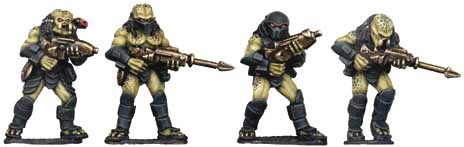
I played it safe and picked two small projects to work on: my EM-4 Terminator robots and some Copplestone Predator warriors. The Terminators are done (and it's barely April?!); you can see them in the top row of the photo. The bottom row includes similarly painted robots from Legions of Steel, which I picked up at an auction (all 4 of 'em, unpainted) for the bargain price of 25 cents. Together, they'll be my cyborg warband for whatever sci-fi or post-apoc skirmish game we play next.

By the way, I obeyed the cardinal rule of painting Terminators by including a human skull on the base of one cyborg. Respect.

Tuesday, February 8, 2011

Introducing 5 new players to Song of Blades & Heroes


Normally introducing just one or two new players to miniatures gaming is a weighty task — there's the rules overview, the introduction of the miniatures and the explanation of the stats, plus turn-by-turn questions about various situational stuff.

Last month I introduced not one or two, but FIVE new players to Song of Blades & Heroes in one epic slugfest game. It's a testament to the strength of the SBH rules engine that the game 1) played fast 2) didn't bog down despite most of the players being relatively new to tabletop minis gaming and 3) gave us the kind of "oooooh man, did you SEE that?!" moments that really define a fun miniatures game.

Anyway, we threw together a quick encounter pitting three undead warbands against an alliance of two human and one elven warband. The classic good guys vs. bad guys scenario. As for terrain, we just threw everything I had on the table without much consideration to the layout. It was no big deal, but one look at these photos and you'll agree that our terrain didn't really make sense. Walls led to forests, which were on top of hills and linked by bridges. Ha! It was a glorious mess, and we had fun.

The game ended early, but the players all got a good taste for how the system runs. Outnumbering and swarming your opponent is key! When we stopped playing, the undead had scored an impressive series of victories against the elves and were threatening to surround the beleaguered humans. In short, it was the perfect fantasy storyline!

Wednesday, January 26, 2011

First blood (literally) for these freshly painted miniatures


It's always awesome to see new miniatures hit the table, especially if they've been painted by folks new to the miniatures hobby. Two players at last night's Song of Blades & Heroes game fielded their own hand-painted warbands, the product of hours of painting, modeling and finessing. Congratulations to Ryan and Chris! I remember painting my very first miniatures back in 1997, and the thrill of placing them on the tabletop (followed by the heartbreak when they got blown to pieces by a plasma gun or a sword thrust or whatever).

Anyway, Chris' Dwarves tangled with Ryan's Lizardmen twice last night, with the Dwarves winning out both times. These photos show the Dwarves, advancing in a tight cluster across the table, being slowly surrounded by the numerically inferior Lizardmen. The color palette for last night's game was particularly attractive, with a dusty red tabletop mat and some autumn-colored trees for scenery. Game on!