Showing posts with label sci-fi. Show all posts

Friday, October 7, 2011

After-action report: Tomorrow's War


After a supply ship was brought down by Neo-Soviet recon elements on the desert world Fornacis V, the decision was made to send in a retrieval squad from Markham's Skybolts, a well-known mercenary company operating dirtside on the planet. The pilot bailed out and made landfall, offering vague details about the Neo-Soviet platoon that was mustering in the dry woodlands around his position. He sought refuge in a nearby colony hab-unit and waited for rescue.

My local club gathered this week to try out Tomorrow's War, the highly anticipated "hard" sci-fi ruleset from Ambush Alley Games and Osprey Publishing. We had been hearing about this game for the better part of a year, as it debuted a while back as an add-on to an existing Ambush Alley title. Now it's being released as a standalone hardcover book — a gorgeous tome, I should add, replete with tons of color photos and example illustrations.

The folks at Osprey were kind enough to send me an advance copy to read and review. What follows here is a battle report of the Skybolts' attempt to extract their pilot from a Neo-Soviet ambush. I'll offer a more substantive review of Tomorrow's War in a future post.

For this game, I ran a scenario straight out of the book. Four players showed up, so I opted not to run a squad and instead perched on a stool spewing rules minutiae for the entire two-hour game.

The photo at the top of this post shows the battlefield at the outset of the game. The three 4-man Skybolt fireteams entered at the bottom of the picture and had to reach the building, grab the pilot and exit the map by Turn 8. Four Neo-Soviet squads were waiting in ambush in the scrub woods surrounding the building.

The first two turns saw the Skybolts players rush their mercenary squads forward, using the rapid move ability to grab some cover on the flanks.

The Neo-Soviet players responded by moving a few squads out of ambush and advancing forward, prompting a couple firefights. In Tomorrow's War, a unit that is being fired on can choose to react by either returning fire or moving away. Moreover, a troop quality check made at the outset of that exchange means that sometimes the targeted squad is able to shoot first, inflicting casualties on the enemy squad before it has a chance to shoot.

Lots of these little firefights — called 'rounds of fire' in the rulebook — erupted as the various fireteams jockeyed for position on the tabletop. The Neo-Soviet troops were low quality but numerically superior. The Skybolt mercenary soldiers were high quality, but few in number. Both sides inflicted a few casualties before the Skybolts managed to charge into the building in the center of the table, quickly locating the missing pilot. From there, they used the comparative safety of the building to pour fire into a Neo-Soviet squad, all but wiping them out.

By this point we were on turn 5, and the mercenary players knew they didn't have much time to dither. They hustled the pilot back toward their edge of the table as fast as possible — which wasn't very fast, considering that squads escorting dependents (the pilot in this case) can't use the rapid move ability! Seeing this, the Neo-Soviet players charged their squads out of cover and began a full-on pursuit across the windswept battlefield. Here they go!

The Skybolt squad in the lower right corner has been 'wiped out' in game terms. The soldiers aren't dead, but there isn't a healthy trooper available to make a first aid check, so the unit stays tipped over until its casualties are assessed. As it happened, this squad wasn't reached by a healthy trooper before the end of the game, so the tipped-over models counted as captured soldiers for the scenario. This particular victory condition put the Neo-Soviet players over the top when we tallied up points at the end.

Anyway, the Skybolts slogged through a fearsome hail of gunfire as the Neo-Soviets enveloped them with superior numbers. Luckily Skybolt one squad that had spent pretty much the entire game on overwatch proved very useful at disrupting the Neo-Soviets advance. With just 3 combat effective soldiers, this little fireteam held up at least twice their number of lower quality Neo-Soviet troopers. This sacrifice allowed the main squad to escape with the pilot at the end of Turn 8. Here's the squad (with pilot) as they make their exit off the battlefield. The rearguard fireteam is just visible in the distance; those soldiers were honored posthumously for their dedication to the mission.

So, the Skybolts won, right? They accomplished their mission? Well, they did, but the Neo-Soviet players also had their own mission objectives. Chief among those were "inflict casualties" and "capture wounded," both of which they did in spades. The Neo-Soviets were able to squeak out a victory based on the specific parameters of this scenario. A marginal victory at best, as one of the Skybolt players pointed out.

Here's a picture of the final positions of the units on Turn 8. The Neo-Soviet players' squads are badly mauled but still active; the Skybolts also suffered proportionate casualties.


Overall I was very pleased with how this scenario turned out. Tomorrow's War doesn't have a point system, which makes it extremely important to craft well-balanced scenarios. This game was an example of that. The forces were evenly matched even though the Neo-Soviet player put about twice as many miniatures on the table as the Skybolts player. The mechanics supported this as well, with the Skybolts using their improved troop quality and weaponry to counter the numerical superiority of the Neo-Soviets.

The victory conditions meant that although the Neo-Soviet players were rather demoralized to watch their troopers die en masse for most of the game, they were still able to accomplish their objectives and win the day. This was a nice departure from so many games, where if you lose a big pile of figures you're pretty much guaranteed to lose the game as a result.

We made a few rules blunders here and there, of course, but overall the game played out quite well. I've played in horribly one-sided scenario games that were just no fun to play. This game moved along briskly and victory wasn't assured until the very last turn of the game! It was "a real nail-biter" as one player pointed out at the start of Turn 8. This game will likely become the go-to squad sci-fi game for our club.


Friday, August 26, 2011

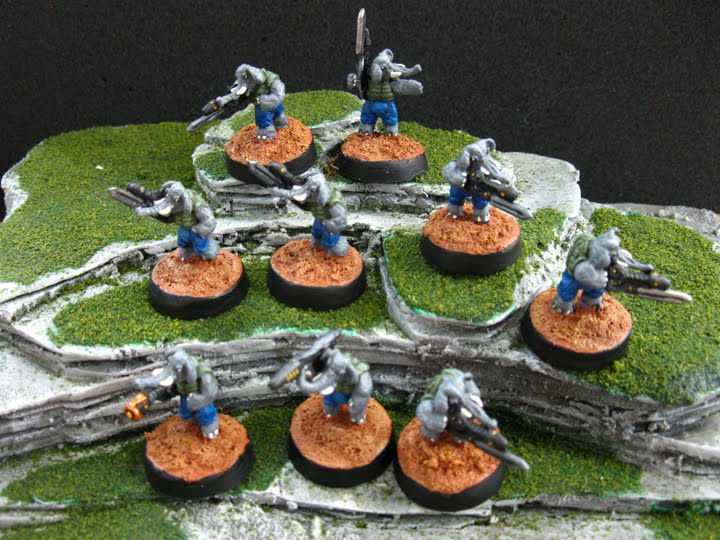
Fully painted: Pachydon sci-fi elephant troopers


Back at Little Wars I picked up a pack of Pachydons, which are these bipedal elephant-men with laser rifles, part of the Blasted Planets sci-fi line. Yes, they are awesome, and completely zany as well. The rest of the line includes gator-men, moose-men and various other genetically modified critters, all armed with the latest 22nd century battle equipment.

These dudes are also a bit small — they are true 25mm figures, so they're a bit runty next to my heroic 28mm stuff. Luckily, all it takes is some imagination to figure out a reason why they're short... obviously, they're from a high-gravity world!


I imagine these guys will hit the field as a mercenary company hired to fight on myriad wartorn world...


Wednesday, August 24, 2011

Wastelands Meltdown: Post-apocalyptic miniatures gaming goodness


Though this blog went totally silent through much of the summer, plenty of gaming was going on. Actually, I rediscovered Magic and have been enjoying the heck of out that game lately. I also took a break from miniatures for a few months ... until GenCon, that is. That got me revved up again, as it always does.

Anyway, on to the substance of this blog post. Last weekend I went to Karl's house to play Wastelands Meltdown, the latest iteration of quick-play post-apocalyptic skirmish rules. We've enjoyed Wastelands v1.2, but this edition promised some upgrades and clarifications.

Of course, the rules took a backseat to the spectacle of gaming on Karl's excellent desert table. We set up a quick scenario — a supply stop for one of my wastelands traders, who was escorted by several heavily armed mercenaries. Karl's raiders (each outfitted with a souped-up mutant vehicle) were split into two groups, which both entered opposite table corners to ambush my merchant and his retinue.

Here's my setup in the center of the battlefield. Karl's terrain looked just smashing when we got it all out on the table.


Karl's objective was to disable 2 of the 3 vehicles that I had clustered around my trading post in the center of the table. My goal was to break Karl's warband by inflicting enough casualties. Here's the table before the game started; Karl's forces will arrive on the top left and top right of the board.


The game was a bit of a bloodbath for Karl. In a foolhardy attempt to try out the vehicle rules (including accelerating and colliding) we both drove our two heavily armed trucks directly at each other, building up quite a head of steam before slamming into each other on one flank of the table. My truck was beefier so I survived; Karl's truck exploded and incinerated most of his survivors, though one chaingunner piled out unscathed.


After that it was just wetwork by my power armored infantry. I had two on the table, and they were the toughest single figures in the game. Of course, they cost about double the points of a typical wasteland raider.

A few highlights from the end of the game follow, with photos.

Karl's truck rammed (and killed) my mercenary commander.


As part of the escape, this gnarly cargo hauler motored up and over a small ridge before running down some hapless wastelands raiders.


Bill the Tracker, armed with his hunting rifle, seized the high ground and spent the entire game taking potshots on any raider brave enough to venture close enough to his position.


Thursday, April 28, 2011

Auditioning for a sci-fi skirmish rule set

There's a reason my local miniatures club is called Chicago Skirmish Wargames — it's because we like collecting small, unique groups of cool miniatures rather than vast, homogeneous armies that take eons to deploy onto the table.

As a result, we've been drawn to small, skirmish-scale rulesets for various genres. We've got fantasy covered with Song of Blades & Heroes, but sci-fi has been a bit more troublesome. The club has spent the last half a year trying out many different sci-fi rulesets, with varying degrees of success and failure. What follows here are my own thoughts (not the club's! I don't speak for everyone) about the rulesets we've sampled, what works and what doesn't.

The ground rules: we were only interested in games that encouraged us to use generic, non-brand-specific miniatures. So, Necromunda (despite being an alright game) was out.

Flying Lead — Published by Ganesha Games (the folks behind Song of Blades & Heroes) this game adds another level of complexity onto its super-simple game engine. Unfortunately, this added complexity proved to be a turnoff to me. The beauty of SBH was that it required virtually no rulebook-flipping once you understood how your warband worked. Flying Lead required considerably more cross referencing, plus we needed to use little counters or tokens to mark the condition of a particular figure (prone, fallen down, etc). I don't like tokens — they clutter up the battlefield and must be removed prior to taking glorious game photos. It's also worth noting that Flying Lead isn't really a sci-fi game — it's more of a modern combat game, with assault rifles and grenades and whatnot. Trying to graft it onto a sci-fi setting might have been our first mistake.

Wastelands — This free PDF is sort of a stripped-down RPG where you assemble a squad of dudes, trick them out with all sorts of equipment and weaponry and send them into battle against each other. The game system itself is functional and decently generic, but not particularly innovative. The best part of this game is that although it's nominally a game about post-apocalyptic battles, you can easily adapt it to a variety of sci-fi settings and genres. We've played this game quite a bit over the last year or so.

5150 — Two Hour Wargames' sci-fi title is pretty well-known, and we were excited to give it a try. As expected, the game played out differently than any other system we'd yet encountered. Basically, your little guys don't always do what you want them to do, and sometimes they flat-out disobey you. It was refreshing, in a way, and of course this sort of ruleset lends itself well to solo play. My only gripe is that 5150's point system is a bit wonky — veteran players will just tell you to play scenarios, which is all well and good, but I need a starting point of some sort.

WarEngine — This is the rules engine that powered the now-defunct game ShockForce, which was first published back in the 1990s. It's a strong, generic system that's been lovingly husbanded by its original creator, Aaron Overton, over the years. It lives on now as a thriving wiki (!) and is 100% free. Of all the games we've auditioned, this one felt the most like what I was after: a true wargame experience that took me back to the halcyon days of playing 40k in high school, but presented in a fully updated, fully supported website that's easy to navigate and totally free of charge. The game itself lets you build units from the ground up using generic statistics and game effects, which really juices my imagination. Once you've got your units built, the engine also has ways to create balanced army composition lists so you can pit your forces against your opponent.

If I had a gripe, it would be that this game seems designed for slightly larger battles than we've played lately. WarEngine games don't feel like much unless you have at least 3-4 maneuver elements (squads, characters, etc) and squads should really be 5+ models to get the full command & control stuff going. So you're looking at 20-40 models — that's almost a 40k army! Right now my club prefers games with 6-12 models per side, but I'm sure we can scale up as needed. Part of that is because we want to keep the buy-in threshold low for new players who might wander over when we're playing at our local store. "Sure, you can play, and if you want your own guys you only need to buy one box of miniatures." That sort of thing.

But still — after many months of discussing, planning and playing, I'm very excited to have found WarEngine. It's the game that I'm most excited about playing right now.

Friday, April 15, 2011

April pledge: painted Predators


"If it bleeds, we can kill it." — Dutch

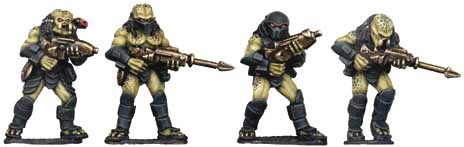
Looking back on this month's painting pledge, a theme emerged: I painted sci-fi miniatures inspired by action movies starring Arnold Schwarzenegger. Last week I posted pics of four Terminator-style robots from EM-4 miniatures. Today I've got photos of four newly painted "Hunter Aliens" from Copplestone Castings — of course, we all know them better as Predators.

These guys were a lot of fun to paint up. After much thought, I painted their skin the same spotted yellow color (inspired by a pic I saw on the interweb) and made their armor look slightly different. These miniatures look a bit shinier in these photos than in real life, but that's OK. They'll hit the table soon, ready to deal death and destruction to future governors, action movie stars and hapless space marines around the galaxy.

And now, a bonus: this was the sci-fi lizard dude I picked up at the paint-and-take table at Little Wars last weekend. I can't remember the minis line he comes from, but he's really cool — he's got a laser rifle slung over his back and a vibro-sword in his hand, ready to plunge through the jungle after his prey. What's that in his left hand? Whatever it is, I painted it red, so it's probably a bit of flesh or something. Again, he's much less shiny in real life.

Painting up this lizard guy has inspired me to do a mercenary squad of oddball sci-ci miniatures to use in multiple game systems.

Wednesday, April 6, 2011

April pledge: painted Terminator robots


In a novel attempt to motivate each other to finish various miniatures, my local club has decided to try out a monthly painting pledge, whereby members can voluntarily declare that they will complete X project during the calendar month. By adding a modicum of accountability we hope to transform our large collective pile of unpainted lead and plastic into a nice bunch of new miniatures to put onto the battlefield.

I played it safe and picked two small projects to work on: my EM-4 Terminator robots and some Copplestone Predator warriors. The Terminators are done (and it's barely April?!); you can see them in the top row of the photo. The bottom row includes similarly painted robots from Legions of Steel, which I picked up at an auction (all 4 of 'em, unpainted) for the bargain price of 25 cents. Together, they'll be my cyborg warband for whatever sci-fi or post-apoc skirmish game we play next.

By the way, I obeyed the cardinal rule of painting Terminators by including a human skull on the base of one cyborg. Respect.

Tuesday, March 1, 2011

Painted Pig Iron: Kolony Ferals and Heavy Infantry


Recently I picked up some excellent miniatures from Pig Iron Productions: the Heavy Infantry and the Kolony Ferals. Both miniature ranges showcase the unique style of Pig Iron's sci-fi stuff. The figures are big without being chunky, hefting weapons that don't look 100% ridiculous compared to their stature.

Compared to other well-known sci-fi miniature lines, the Heavy Infantry troopers have believable armor and equipment, something that looks like a distant relative of the battle armor worn by the Colonial Marines in "Aliens." This inspired me to do a camouflage paintjob, the first time I've ever tried to do camo on a squad of sci-fi miniatures.

I think it came out pretty well! These guys were quick to paint up, and it's hard to describe how different they are compared to traditional sci-fi miniatures. They're not posed heroically; they're standing like a normal guy would stand if he were wearing 80 pounds of armor. I like that you can get a little glimpse of their faces behind those half-helmets...it adds a little humanity to the squad.

They'll soon face off across the table from my new Kolony Ferals!


These dudes are just gnarly. Dressed in rags, with creepy cybernetics poking out everywhere, they're obviously the dregs of society, living on the outskirts of civilization and sifting through the accumulated effluvia of some gritty, futuristic colony outpost. They're among the most unique miniatures I've painted in a while, and I've got some more on order!


My group is playing around with 5150, the generic sci-fi skirmish ruleset from Two Hour Wargames, so these figures will likely hit the table soon. Pictures to follow!

Friday, December 31, 2010

Future War Commander with rebased MechWarrior clix

After a few very successful online trades, Karl and I found ourselves with a surplus of MechWarrior clix. Maybe surplus is too generous — we each snagged hundreds of mechs, tanks and infantry for the mostly-defunct game. Our plans are to rebase them as "proper" miniatures and play Future War Commander, the excellent mass battle game from the publisher of Blitzkrieg Commander, and we tried our hand doing that very thing last night.

I've played plenty of Blitzkrieg Commander, so there wasn't a learning curve at all for FWC. Karl picked up the game after just a few turns too.

We played the Surgical Strike scenario, with two 2,000-point armies. I used the Reaper/CAV army lists to create both of our armies; this list, while not expressly designed for MechWarrior units, was nonetheless full of ideal surrogates for the tanks and mechs that we pushed around the tabletop. A MechWarrior Marksman M1 tank was easily statted up as a CAV Wolverine tank, for example. There are also several fan-made BattleTech lists floating around on the web for use with FWC.

For the scenario, we set up two installations — Forward Hangar JX-7 and the Noonien Astrophysics Laboratory — as the objectives. I was the attacker; it was my job to push onto the table and infiltrate the two facilities using my infantry units. As the defender, Karl was allowed to deploy a small force near each installation while the bulk of his army deployed near his table edge.

As the photos show, the two facilities were positioned on opposite ends of the table, with several built-up city blocks separating them. The buildings are actually superb paper models from Dream Pod 9 (perfectly in scale at 10mm), assembled by me and Karl and mounted on vinyl tiles to add stability. They're cheap, modular and stackable, so you can create multiple stories and entire city blocks with ease.

I moved onto the table with my infantry-heavy force and immediately sent the bulk of my forces toward the Noonien Astrophysics Laboratory. For the remainder of the game, this sector of the table saw the fiercest fighting, although a few firefights erupted near Forward Hangar JX-7 on the opposite flank.

I scored two lucky shots early in the game and destroyed two of Karl's three battle tanks. Behind a heavy mech and a tank bristling with weapons, 6 squads of my infantry advanced steadily on the Noonien Astrophysics Laboratory, led by an elite unit mounted in an infantry fighting vehicle.

This spearhead surged forward under heavy fire, delivering its squad of battle-armored soldiers to the laboratory entrance — where they were met with a withering hail of fire from the defenders of the installation. My elite infantry was forced to fall back in the face of the entrenched defenders.

But it was only a matter of time before I overwhelmed the Noonien defenders with sheer weight of numbers. Moreover, a lopsided turn of point-blank shooting by my armored vehicles on the opposite flank had crushed Karl's defenses, leaving behind two burning tanks and a flaming mech wreck. Unopposed, my remaining infantry raced toward Forward Hangar JX-7.

By turn 7 I had moved four squads of infantry into the Noonien Astrophysics Laboratory, thereby allowing me to roll on a cool chart to see if my guys were able to carry out their mission. Indeed they were! Charges were set and the lab exploded while my soldiers evacuated to safety.

It was a very fun game, and a good reminder of why I like the "Commander" series of games. Unit statistics are abstracted a bit, but the focus on command units ensures that players remain "in the game" turn after turn. Both Karl and I agreed that we could easily scale our game up to 4,000 points (or more) per side. We definitely have the miniatures to do that!

Thursday, December 9, 2010

Invading the solar system with Full Thrust

Tim and I found ourselves with a random weeknight free, so we got together for a game of Full Thrust. A couple months ago Tim picked up a fleet of Cold Navy ships at an auction, and this was his first outing with his newly painted fleets. They ended up being two separate factions: the brown/yellow asteroid pirates and the green/blue...somethings. Yeah, we haven't done much with the backstory yet.

I managed to come up with names for my fleet of blue-and-gray ships — all Scandinavian names from various cultures throughout history. I have this idea that they're a quasi-Germanic far-future federation that's exploring the stars, etc. I definitely had a lot of fun saying stuff like "OK, the Rensselaer is going to open up with its laser batteries while the Gothenburg II tries a torpedo run."

Tim had been on a planet-making bender over the last couple of weeks...he literally showed up with a dozen painted planets, so we put about half of them on the table and came up with a quick scenario: the invasion of an alien solar system. Our two fleets would compete to land ground forces on the planets in an attempt to conquer and subjugate them. To land a strike team, a ship (any ship, we said) had to enter orbit around the planet and spend a turn orbiting it to drop sufficient troops and supplies. We came up with some fast-and-dirty rules to accomplish this, based around the Full Thrust framework, and then went at it.

My kitchen table is large and square, but it's only 5x3, whereas my space hex mat is 6x4. So we were playing on a slightly smaller area than our previous game. In retrospect, we could have compensated by changing all measurements from inches to centimeters, but we realized that midway through the game. Oh well — it just meant that our two fleets crashed together one or two turns ahead of schedule.

Tim sent his smaller ships to the planets nearest his side of the table, and I did the same on my side. Our largest battleships all converged on each other in an attempt to engage and destroy the most dangerous ships in the opposing fleets. Thus there developed a huge scrum between battleships in the center of the table, with little support ships flitting around on the fringes, landing troops and supplies in the middle of a huge firefight.

This proved to be my undoing. I was doing fine at mauling his big ships, but I had trouble getting my smaller ships into orbit to land strike teams. In the end, both of our fleets were hurting badly — note the raging inferno engulfing the bridge of the battleship Ostrogoth in the pic below — but he had claimed a decisive victory by occupying 4 planets to my 2.

Interestingly, one of those planets was occupied by one of his strike teams and one of mine. Full Thrust dovetails nicely with Dirtside and Stargrunt, two other sci-fi games published by Ground Zero Games, so it's possible that we could play out the fight between the two landing parties at a later date using either of those two other systems. Both include rules for orbital bombardment, which could definitely be interesting considering we both had ships in the vicinity of the planet when the game ended...

Sunday, November 7, 2010

Battle report for Wastelands, the post-apocalyptic skirmish game


My regular wargaming group got together last week to try out Wastelands, a skirmish miniatures game set in a post-apocalyptic world. The rules are philosophically similar to Song of Blades & Heroes — meaning they're simple, customizable and packed with RPG-like flavor — so we knew this would be an easy game to pick up and play. Plus, the game is generic enough to support all manner of post-apocalyptic scenarios and factions: Road Warrior-style highway raiders, Terminator machines, 40k-style shock troopers and everything in between. Games generally include anywhere from 3 to 10 figures, plus maybe a vehicle or two.

Karl, one of the players in the group, had a fantastic desert board set up at his place, and we were able to get in two games, each lasting just over an hour or so. Each game was a three-way slugfest; we avoided crafting a specific scenario because we really just wanted to see how the game would play.


The games were a lot of fun, but the suggested point value for each team (300 points) offered some wildly disparate teams. For example, 300 points got 6 Mad Max-style gangers, or 3 tricked-out shock trooper commandos, or 3 nomadic survivors plus a rustbucket police cruiser.

The 3 armored shock troopers proved to be the most potent fighting force on the board that evening, owing mostly to their bitchin' body armor. They didn't have numerical superiority, but they were able to walk all over the nomadic survivors and the Terminator-style robot infantry, as seen in these photos.


We all agreed that, despite the prowess of the shock troopers, it's just not that much fun to have a team consisting of only 3 guys, so we are definitely going to raise the point cap a bit higher next time we play, maybe up to 500 points or so. I mean, the point of playing miniatures wargames is to get fun toys on the table, right?


Also, the lone vehicle didn't really perform as we hoped it would. I didn't buy a gun for it, so all it was able to do was lurch back and forth, attempting to ram various enemies. It looked cool on the table, but it ultimately killed no one and was itself destroyed piecemeal in both games. I think the game will play much better with several vehicles zipping around on the board, rather than one big moving target that everyone shoots at each turn.


Lastly, Wastelands had its share of inconsistencies and muddled rules. We ended up houseruling more than a few key things over the course of two games. This wasn't a big deal, and I understand that Wastelands is a DIY release that probably didn't benefit from an outside editor, but it's worth mentioning. I'm sure we'll codify our Wastelands notes in some sort of house rules addendum that we can all share.

Wednesday, September 8, 2010

My ever-changing gaming interests

It's been months since I've run a roleplaying game, mainly because I've been spending lots of time painting miniatures — and consequently I've been gravitating toward games that will give me an opportunity to actually use those painted miniatures!

Lately I've found a group of guys in Chicago who play Song of Blades & Heroes, the excellent little fantasy skirmish game that I discovered earlier this year. We've been meeting twice a month, or thereabouts, to talk trash and move our little fantasy figures around the table. It doesn't hurt that the game shop where we meet is just 4 blocks from my apartment in Chicago!

The thing with Song of Blades & Heroes is that it's almost a roleplaying game. You can choose unique-looking miniatures, name your characters, send them on specific tasks, etc. The game mechanic is simple enough that it can be adapted to handle typical roleplaying tasks.


For our most recent game, we set up some dungeon blocks to create a full-on tabletop labyrinth, and then we rolled up a "quest for the magic item" scenario that pitted a squad of dark elves against a marauding crew of gladiators and a patrol of evil snakemen. Badass!

Since GenCon, I've become enamored with sci-fi miniatures gaming — starships in particular, probably a direct result of me sitting in on an excellent demo of War Rocket, the pulp sci-fi starship game from Hydra Miniatures.

During the drive back to Chicago, I realized that I loved the War Rocket ruleset, but I decided to collect a more "generic" looking set of starships, so I could potentially use them for Full Thrust, Starmada or any of the other fleet-action rulesets out there. Full Thrust, by the way, is available for free on the web from Ground Zero Games.

I'm just a week or so away from trying out my first game of Full Thrust (or War Rocket, depending on the group). For now, I'm trying to create my own sci-fi milieu, rather than use a published setting. (Aside: Starship minis games seem to have this disturbing tendency to make all their factions into fascimiles of political blocs that exist today on Earth. So we have space Russians, space Japanese, space Germans, space Americans, etc. Weird, that. How about some aliens?)

I'm also deliberately building my starship fleets using a variety of models from different manufacturers. This is explicitly encouraged in Full Thrust, much to my delight. So far, I'm using models from Silent Death, Firestorm Armada, Star Fleet Battles and AeroTech. Check back for photos soon!

My sci-fi bug hasn't stopped with starships, though...I'm contemplating getting some old MechWarrior click-base figures to rebase and use with Future War Commander or Dirtside. I priced out some pieces last night, and it looks like I can get two armies for $30 or so. And of course, they're prepainted...


Thursday, December 4, 2008

Blue Planet, Midnight For Cheap at FFG Holiday Sale

Thanks to the good folks at the Blue Planet RPG mailing list, I found out that Fantasy Flight Games is having their annual holiday sale. I missed this blowout last year, but my buddy snagged all the books for the Midnight line for $5-10 each. Quite the discount, especially for a very well-supported 3.5 setting like Midnight.

The real treat, though, is the Blue Planet portfolio. As near as I can tell (FFG’s site is blocked at work, bleh) each BP book is $5. That means you can get the whole line for under $50. As longtime RPG Diehard readers will know, Blue Planet is one of my all-time favorite game lines; it’s also the richest, most detailed sci-fi setting I’ve ever encountered. When I lived in Missouri, I had the chance to meet (and game with) Jeff Barber, Blue Planet’s creator, who later went on to write the original Midnight core rulebook.

So do your part, drop a Hamilton or two, and get some great books!

Thursday, June 26, 2008

Starting a New Game

Over the past week, Pat and I got involved in a new game.  Both of us and one of our other gamer buddies each tapped a person who we knew and have played with at least once before - the aim was to put together a group that's fun and story oriented.  Early signs point to good things on the horizon.

We're using the Wild Talents system, and from what I can tell thus far, it looks cinematic and gritty at the same time (which is just what I'm looking for).  The system is for a supers game, but we're playing a science fiction game in the far flung future.  The 6 of us hashed out the setting over email, and I think it's pretty cool.  Maybe I'll post a more detailed description later, but the skinny of it is this: 3 known alien races with different goals, human upstarts with transhuman abilities, the threat of a scary alien invasion on the horizon, ancient artifacts and unknown planets, and weird physics.  I'm the GM, and I don't know yet exactly how all this is going to fit together.  But I do know that the setting is volatile and provides opportunity for politics, exploration, and all out war.   Seems like a good set up to me.

Character gen went pretty well.  I like the characters so far - they each have different powers and different goals.  Hopefully, we'll be able to knit all of them together with an overarching goal that they can all buy in to.  In fact, I think this is crucial after our Burning Wheel sessions.

So, in short, I like the player mix so far, I like the setting we've collaboratively made, and I like the level of excitement that seems to be there.  I'm hoping we can get a regular game going with some momentum, and at this point, I just want to play.  Theorizing about rpgs and discussing them is all well and good (and certainly amusing), but damn the torpedos!  I just want to roll some dice, blow some shit up, and put these new characters in some really tough situations.

Saturday, June 21, 2008

Found the treasure! Or, a visit to Half Price Books in Dallas

I've been an energetic patron of Half Price Books since my first visit in years past. It's a super cool store with a great mission, plus they invariably have a great selection of gaming books and graphic novels. Pricing is intuitive: Everything is half-off the cover price.

Well, I dropped into what I soon learned was the flagship store and corporate headquarters of Half Price Books today while in Dallas for business. Here's the setup: The day's work was finished, and I was cruising Park City in a rented Malibu. The auto powered its way over a hill - and then I saw it. A huge red sign looming over the freeway, inviting me in with promises of out-of-print books and CDs.

I stopped in and browsed for a goodly while. They had a ton of old D&D stuff, including a good half-dozen books with spine credit by Gary Gygax. Cool stuff - to bad it was sort of falling apart. The next shelf held a bevy of oddball games from the beginning of the 21st century, when the Grim Meathook Future started looking more and more likely and movies like The Matrix glamorized the idea of firing off thousands of bullets in a heavily populated city. Gritty, street-level urban games; I saw Underground, Heavy Gear and a glut of World of Darkness titles. Mmmm, darkness. I love a good dark game.

I ended up walking out with a barely used copy of the Tribe 8 core book. Tribe 8 has been my elusive quarry for many years: I've known about it for a good while, and I've sort of mentally reserved a space on my post-apocalyptic shelf for it. In the past, I kept running across the splat books, but never the real thing. Today it is mine! It actually wasn't marked with a price, and I was bracing myself to cough up $15 if the clerk decided it retailed for $30. But he surprised me with a svelte $5.98 price, which I paid gladly.

Next up for me: Gamma World, Darwin's World, All Flesh Must Be Eaten, Redline and Unhallowed Metropolis. And A|State is available on PDF now...

Friday, June 6, 2008

The 500-word campaign setting: Dust to Dust

Ben challenged me to hammer out a 500-word campaign setting. What follows is a little bit longer than that, and it's inspired by a few disparate sci-fi elements I've been chewing on lately: the recent Phoenix Lander Mars mission, the new Mutant Future D&D setting and my own musings about what might happen if a Traveller crew ever settled down somewhere. Feel free to let me know what you think.

***

“Dust to Dust”

One hundred years from now, humans reached the stars, clawing hungrily into the heavens and leaving behind a cracked, ruined Earth. In the waning days of the n ext century, technological advancements ground to a halt as petty resource wars erupted on the planet’s blasted surface. Colonization was the only hope of a dying planet, and so various factions, guilds, governments and groups sped through the cosmos toward dozens of carefully mapped destinations.

These star systems, chosen by desperate scientists, offered the best hope of yielding up Earth-similar planets for colonization. Such was the urgency of the humans’ departure that the candidate planets were chosen based on telemetric data; no satellite observation was conducted. Years passed, and eventually the refugees’ massive fusion-powered spacecrafts arrived in orbit around their destinations. At that point, they were quite literally scattered throughout the galaxy without hope of ever contacting one another again. For all intents and purposes, each colonization ark was on its own, carrying in its swollen belly all the necessities for settlement: agricultural equipment, energy generators, prefab buildings and simple vehicles.

The human cargo, however, varied by each ship; some vessels launched with only a skeleton crew, hoping to birth and rear a new generation in transit. Others were full to the brim with the determined masses, each desperate soul willing to sacrifice everything for a chance at a new life. Still others made landfall after a plague or famine swept through the city-sized starship, leaving only a few grief-stricken survivors to begin anew.

As expected, the myriad planets the colonists found were largely inhospitable. Bereft of all but the hardiest life, these planets were wracked by dust storms and scoured clean by extreme weather and temperatures. Slowly, arduously, the exhausted colonists made landfall and unpacked their terraforming equipment. They had known this was coming; it was too much to hope that the planets might embrace their arrival with open arms. But no matter: The colonists were prepared to seize their future, to yank it from the dusty soil of their adopted home…

“Dust to Dust” is a campaign setting about terraforming efforts on a frontier world in the near future. Players and the GM should sketch out the specifics of “their” world – the environment, the geography, the weather, etc – as well as the look and feel of their colony ark. Was it a large ship that landed thousands of determined settlers over the course of many years? Was it a smaller relief vessel lacking some basic, important terraforming tool? Did half the colony crew die during a botched landfall attempt? Players should flesh out key characters and factions unique to their colony world as well. Influential families, corporations and organized crime could easily have taken hold in the burgeoning colony.

In game terms, the colony is assumed to be brand-spankin’-new, probably fewer than three months old. That way, the PCs are thrust immediately into the daily struggle for survival on the frontier world. Machinery breaks down regularly and replacement parts are in short supply. Political factions struggle for influence over the colonization effort, each convinced that they can help this tiny human toehold achieve sufficiency. Scientists make daily forays into the wastes looking for much-needed resources; some never return. At night, the masses huddle inside their prefab shelters and listen to an alien wind howl.

The most important character in the game is the planet itself and the mystery it represents. It can be both the savior and executioner for the squalid colony.