
There's a reason my local miniatures club is called Chicago Skirmish Wargames — it's because we like collecting small, unique groups of cool miniatures rather than vast, homogeneous armies that take eons to deploy onto the table.
As a result, we've been drawn to small, skirmish-scale rulesets for various genres. We've got fantasy covered with Song of Blades & Heroes, but sci-fi has been a bit more troublesome. The club has spent the last half a year trying out many different sci-fi rulesets, with varying degrees of success and failure. What follows here are my own thoughts (not the club's! I don't speak for everyone) about the rulesets we've sampled, what works and what doesn't.
The ground rules: we were only interested in games that encouraged us to use generic, non-brand-specific miniatures. So, Necromunda (despite being an alright game) was out.
Flying Lead — Published by Ganesha Games (the folks behind Song of Blades & Heroes) this game adds another level of complexity onto its super-simple game engine. Unfortunately, this added complexity proved to be a turnoff to me. The beauty of SBH was that it required virtually no rulebook-flipping once you understood how your warband worked. Flying Lead required considerably more cross referencing, plus we needed to use little counters or tokens to mark the condition of a particular figure (prone, fallen down, etc). I don't like tokens — they clutter up the battlefield and must be removed prior to taking glorious game photos. It's also worth noting that Flying Lead isn't really a sci-fi game — it's more of a modern combat game, with assault rifles and grenades and whatnot. Trying to graft it onto a sci-fi setting might have been our first mistake.
Wastelands — This free PDF is sort of a stripped-down RPG where you assemble a squad of dudes, trick them out with all sorts of equipment and weaponry and send them into battle against each other. The game system itself is functional and decently generic, but not particularly innovative. The best part of this game is that although it's nominally a game about post-apocalyptic battles, you can easily adapt it to a variety of sci-fi settings and genres. We've played this game quite a bit over the last year or so.
5150 — Two Hour Wargames' sci-fi title is pretty well-known, and we were excited to give it a try. As expected, the game played out differently than any other system we'd yet encountered. Basically, your little guys don't always do what you want them to do, and sometimes they flat-out disobey you. It was refreshing, in a way, and of course this sort of ruleset lends itself well to solo play. My only gripe is that 5150's point system is a bit wonky — veteran players will just tell you to play scenarios, which is all well and good, but I need a starting point of some sort.
WarEngine — This is the rules engine that powered the now-defunct game ShockForce, which was first published back in the 1990s. It's a strong, generic system that's been lovingly husbanded by its original creator, Aaron Overton, over the years. It lives on now as a thriving wiki (!) and is 100% free. Of all the games we've auditioned, this one felt the most like what I was after: a true wargame experience that took me back to the halcyon days of playing 40k in high school, but presented in a fully updated, fully supported website that's easy to navigate and totally free of charge. The game itself lets you build units from the ground up using generic statistics and game effects, which really juices my imagination. Once you've got your units built, the engine also has ways to create balanced army composition lists so you can pit your forces against your opponent.
If I had a gripe, it would be that this game seems designed for slightly larger battles than we've played lately. WarEngine games don't feel like much unless you have at least 3-4 maneuver elements (squads, characters, etc) and squads should really be 5+ models to get the full command & control stuff going. So you're looking at 20-40 models — that's almost a 40k army! Right now my club prefers games with 6-12 models per side, but I'm sure we can scale up as needed. Part of that is because we want to keep the buy-in threshold low for new players who might wander over when we're playing at our local store. "Sure, you can play, and if you want your own guys you only need to buy one box of miniatures." That sort of thing.
But still — after many months of discussing, planning and playing, I'm very excited to have found WarEngine. It's the game that I'm most excited about playing right now.
Showing posts with label wargames. Show all posts
Showing posts with label wargames. Show all posts
Thursday, April 28, 2011

Wednesday, May 12, 2010
A horribly imbalanced game of DBA with 20mm soft plastic figures

I got together with a friend last week to play my first game of De Bellis Antiquitatis, the well-known ancient/medieval wargame commonly abbreviated as DBA. We liked the game, but we fielded very, very imbalanced armies consisting of the entirety of my 20mm-scale Hundred Years War collection, with each player using half of the figures...hardly a strategic army; more like a mishmash. Our game stagnated at some points for sure.
I've played a lot of wargames in my day, but they've mostly been single-figure affairs, where each guy stands on his own base and attacks separately, etc. DBA uses stands of figures representing hundreds of even thousands of combatants, enabling players to fight out some really big battles.

The problem with our game is that I had painted up way too many sword-and-shield infantry (known in the game as "blades"). These guys are elite troops, and most of the English and French army lists from the Hundred Years' War give each side no more than 2 or 3 of these units, because they represent dismounted knights. The bulk of the army is supposed to be composed of basic spearmen, longbowmen and mounted cavalry.
So we had waaay too many blades on each side, which resulted in the game turning into a massive slugfest in the center of the table. Again, this was because we were using only what I had painted up. I'm sure the next time we play, we'll be able to assemble much more balanced (and historical) armies from my collection.
I leave you with these two images, showing the downfall of a battalion of stalwart English longbowmen to a group of thundering knights. The game actually has rules that make longbowmen potent against mounted knights, but we misread them and the bows were slaughtered. That was the beginning of the end of the game for me, although I made my opponent pay dearly for his victory.


Friday, March 12, 2010
These 1/72 guys look better in a group

I've been painting off and on the last couple of weeks, and I've finally ended up with a decent array of 1/72 medieval knight dudes. I'm planning to use these for mass combat in a variety of game systems, so everything has been kept intentionally generic. They're just a bunch of guys with swords and shields, which is great. And they look pretty sharp in a big group—and they're SO CHEAP.

The cavalry take a long time to paint, not the least because I am running out of ways to paint the horses. Moving forward, I think they're just going to be black or brown, to save time. I'm very pleased with how the bases have come out...this is my new basing scheme, which takes a lot of time but looks very nice when finished.
I wish I could say my painting is drawing to a close, but it's not. I just picked up 35+ random fantasy miniatures at a gaming auction last weekend. Add that to the pile of unpainted dudes sitting around on my desk, and I should be well occupied until this time next year.

Wednesday, February 10, 2010
Wargaming on the cheap: 1/72 plastic soldiers


A couple weeks ago I picked up a big pile of 1/72 scale plastic medieval soldiers and cavalry on eBay for $5. I've dabbled in 1/72 scale figs before, primarily for WWII wargaming, but these guys look pretty sharp (and the price was definitely right). Check out my preliminary color schemes above. I could drop another $30, I think, and get all the miniatures I'll ever need.

So that's got me thinking about rulesets for medieval wargaming. I don't necessarily want to do full-on ancients, because I'm not interested in the historical stuff whatsoever. That rules out De Bellis Antiquitatis, but I'm still keen to take a look at Hordes of the Things, the fantasy spinoff ruleset.
But really, I think my search is at an end, because I just found out yesterday that Games Workshop's Warmaster rulebook is available free on the Web. While the magic stuff and esoteric races probably won't hold much interest for me right now, I think Warmaster's core mechanic is fantastic. It really reflects the ebb and flow of battle on a strategic scale, and it doesn't bog down with tactical minutia (which is better handled by other rule systems). Instead, it's a clean-flowing game that simulates the movement of hundreds of troops on a battlefield.
Plus it's free.
And while it's designed for 10mm scale gaming, I'm guessing it'll scale up just fine for 1/72 (which is 20mm in scale). And I've got a fair collection of terrain for my kitchen table.
What I'd really like to do is use this ruleset to play out some grand battles in George R.R. Martin's Song of Ice and Fire setting—his books were full of such clashes. To that end, I'll be painting up my 1/72 dudes in generic-looking paint schemes that might pass for the noble Houses of Martin's Westeros.
Thursday, July 2, 2009
Blitzkrieg Commander: Breakthrough on the Dnieper
A couple friends came over last week to try out Blitzkrieg Commander, a WWII tabletop wargame rule set that I picked up last month but hadn't yet tried out. Up until now we'd been playing Crossfire with my 10mm WWII figures. Crossfire is a fun game, but the game sort of assumes that each group will house rules the hell out of it. And although I'm working on some house rules for Crossfire, they're not yet complete--so we've had only marginal amounts of fun with the game, owing to its half-finished nature.
I had high hopes for Blitzkrieg Commander, and it didn't disappoint. The rules are quick and intuitive--just tell the players how to issue orders, explain the few modifiers that the game uses, and you're off and running!
We played an "Exploitation" scenario taken from the main rulebook. I set the game in October 1943 as part of the Red Army's crossing of the Dnieper River. For our game, the Russians had already penetrated the main German line, so the German players would be commanding reserve units that weren't properly deployed for the coming assault.
Here's a look at my kitchen table just before the game started. We were playing "deep," so the Soviets entered on the closest short table edge and had to push through several layers of German defenses.

Here's the Soviet assault force: 6 T-34/76s (each with 1 infantry squad riding) plus an SU-122 with a few more infantry squads on the other flank. The BA-10 armored car is one of the two command units.

The Germans were deployed in several different areas of the board, which prevented them from mustering a solid counterattack initially.

In addition to scattered infantry and MG squads, the Germans had 2 Tiger I tanks, 1 Panzer IV tank and 1 Sturmpanzer Brummbar.

Plus a PaK-4o anti-tank gun! It was dug-in behind some hedges and drew first blood once the game got underway.
'

And thus the game began! The Russians had to capture as much territory as possible, and they started off by moving forward toward the small village in this photo. Both Red Army command units gave lackluster performances in these opening turns, giving the Germans time to pull back some troops and open fire with their PaK-40. The first kill was a T-34.
 The Soviets dumped their tank riders in this small village and attempted to drive straight through to continue the assault. Unfortunately the Brummbar was close enough to provide a serious roadblock to this plan.

On the other flank, the infantry pushed through another small village but spent waaay too much time attacking a dug-in MG unit. Because of this, they weren't able to keep up with the rest of the assault, and they didn't do too much damage. Note the smoking T-34 and SU-122 in the background.
 After several turns, the German players had the bright idea to move their Tigers up into the fray. They actually drove right up and parked atop the central hill, thus threatening a huge area with their guns. This maneuver proved to be the deathblow for the Soviets, as their 4 remaining T-34s spent the rest of the game trying desperately to stay away from the Tigers.
 Both the German and Soviet infantry units chewed each other to pieces in the urban areas, but not before the German infantry, armed with panzerfausts, drove several T-34s back into range of the Tigers. The final play came as the Tigers plunged into the woods in pursuit of the two remaining T-34s. The Soviet player (me) conceded the game after this photo.
 All in all, we found Blitzkrieg Commander to be a very satisfying game. In retrospect, I should have given the Soviet side a lot more points; the rulebook suggested that the attacker have double the points as the defender. The scenario as I set it up didn't have quite that disparity.
The possibility of failing a command role at a critical time made for some very exciting play. We also liked that the turns weren't fixed; players could issue a bunch of orders, or fail after just one or two, thereby ending their turn.
We didn't include artillery or air support in our game, as we were just trying out the rules and didn't want to further complicate our learning session. But for our next game, I think we'll do a straight point build and see how the game plays that way.
I had high hopes for Blitzkrieg Commander, and it didn't disappoint. The rules are quick and intuitive--just tell the players how to issue orders, explain the few modifiers that the game uses, and you're off and running!
We played an "Exploitation" scenario taken from the main rulebook. I set the game in October 1943 as part of the Red Army's crossing of the Dnieper River. For our game, the Russians had already penetrated the main German line, so the German players would be commanding reserve units that weren't properly deployed for the coming assault.
Here's a look at my kitchen table just before the game started. We were playing "deep," so the Soviets entered on the closest short table edge and had to push through several layers of German defenses.

Here's the Soviet assault force: 6 T-34/76s (each with 1 infantry squad riding) plus an SU-122 with a few more infantry squads on the other flank. The BA-10 armored car is one of the two command units.

The Germans were deployed in several different areas of the board, which prevented them from mustering a solid counterattack initially.

In addition to scattered infantry and MG squads, the Germans had 2 Tiger I tanks, 1 Panzer IV tank and 1 Sturmpanzer Brummbar.

Plus a PaK-4o anti-tank gun! It was dug-in behind some hedges and drew first blood once the game got underway.
'

And thus the game began! The Russians had to capture as much territory as possible, and they started off by moving forward toward the small village in this photo. Both Red Army command units gave lackluster performances in these opening turns, giving the Germans time to pull back some troops and open fire with their PaK-40. The first kill was a T-34.
 The Soviets dumped their tank riders in this small village and attempted to drive straight through to continue the assault. Unfortunately the Brummbar was close enough to provide a serious roadblock to this plan.
On the other flank, the infantry pushed through another small village but spent waaay too much time attacking a dug-in MG unit. Because of this, they weren't able to keep up with the rest of the assault, and they didn't do too much damage. Note the smoking T-34 and SU-122 in the background.
 After several turns, the German players had the bright idea to move their Tigers up into the fray. They actually drove right up and parked atop the central hill, thus threatening a huge area with their guns. This maneuver proved to be the deathblow for the Soviets, as their 4 remaining T-34s spent the rest of the game trying desperately to stay away from the Tigers.
 Both the German and Soviet infantry units chewed each other to pieces in the urban areas, but not before the German infantry, armed with panzerfausts, drove several T-34s back into range of the Tigers. The final play came as the Tigers plunged into the woods in pursuit of the two remaining T-34s. The Soviet player (me) conceded the game after this photo.
 All in all, we found Blitzkrieg Commander to be a very satisfying game. In retrospect, I should have given the Soviet side a lot more points; the rulebook suggested that the attacker have double the points as the defender. The scenario as I set it up didn't have quite that disparity.
The possibility of failing a command role at a critical time made for some very exciting play. We also liked that the turns weren't fixed; players could issue a bunch of orders, or fail after just one or two, thereby ending their turn.
We didn't include artillery or air support in our game, as we were just trying out the rules and didn't want to further complicate our learning session. But for our next game, I think we'll do a straight point build and see how the game plays that way.
Friday, May 29, 2009
Third Crossfire game, bring up the armor!

I organized my third Crossfire game earlier this week. We played a small engagement inspired by Ponyri, a village that was part of the much larger Battle of Kursk in 1943. Against the backdrop of the days-long assault, a German infantry company, supported by tanks, attempted to probe Soviet positions outside Ponyri—mindful that reinforcements from the larger battle could arrive at any time. We used my 10mm WWII miniatures, plus vehicles from my World Tank Museum collection. Pardon the fuzzy phone camera image; I've consistently forgotten to bring my actual camera.
Four players showed up, so I set them up as two teams and sat back to interpret rules and referee the game as best I could. Luckily Nico, a buddy from our Savage Worlds rpg, was there, and he digested a lot of rules prior to the game. This proved immensely helpful as we began the game.
Unfortunately, the scenario was quite one-sided and ended with a bloodbath for the Germans. The Germans had two rifle platoons, two on-board mortar squads with spotters, two Panzer IIIs and two Panzer IVs. This was arrayed against two Soviet rifle platoons supported by three 45mm antitank guns, all hidden in the village. Two KV-1s were available as reinforcements after five turns.
Much of the tactical imbalance—code for "Soviet butt-kicking"—in this game was due to a less-than-thorough understanding of how the armor rules worked, and how armor differed from infantry in terms of on-board effectiveness. Chalk that up to my own inexperience with the rules.
Basically, the two German platoons advanced from the woods to the outskirts of the village and quickly ran into two dug-in Soviet platoons. They slugged it out for a couple initiatives, but several stunning die rolls virtually destroyed the German infantry before the armor could make it to the show. Likewise the on-board mortar units didn't come into play until it almost didn't matter.
In retrospect, both German players agreed that they should have moved up their tanks first and used armor and indirect fire from the mortars to recon the suspected Soviet positions. It would have taken more time, but it would have been a lot less risky and would have allowed the infantry to move in once the Soviet squads had been identified. Plus the armor action might have prompted the Soviet players to reveal their 45mm anti-tank guns in order to re-deploy them.
I had come up with this scenario on my own, but I later found that Steve Thomas had previously detailed and played a much larger scenario based on the same skirmish. I was pretty pleased to see that our two setups, despite being written for very different sized games, had a lot of key features in common.
Friday, May 22, 2009
Second Crossfire game, more 10mm WWII musings

I hosted another Crossfire game last week, this one at Chicagoland Games, the new game store that opened up just four blocks from my apartment in Chicago.
I had 3 players show up for the game, plus another who arrived after we started and provided tactical advice during the game. Since we had a lot of players, we decided to re-play my original scenario from last week (a Soviet raid against Germans protecting a StuG III in a small village) as a 2-on-2 team game.
I'd never really tried Crossfire with multiple players, and the structure of the game makes such setups kind of tough to execute—but we only played one company per side, which is still pretty small for Crossfire standards. Basically the two players on each side split control of their forces, with most players getting a platoon or two of troops to command, along with a vehicle or anti-tank gun.
We also stuffed a lot more terrain on the table, but I still felt like we could have used more. The Soviets advanced through the woods and farmland to find and disable the StuG III, which was being defended by Germans in the burnt-out ruins of a small village. The victory conditions allowed the Soviets to win if they had two infantry squads in base-to-base contact with the StuG III at the end of any initiative; the Germans, however, could win if they killed off 6 or more Soviet infantry squads.
It was a very well-balanced game, with the Germans having slightly fewer infantry troops, but more versatile support weapons (in the form of a PaK-40 antitank gun and the aforementioned StuG III assault gun). The Soviets had about a third more infantry units, and they had a single T-34/76 that arrived after Initiative 5.
The performance of vehicles in this game ran the gamut from great to terrible. The Soviets were a bit too aggressive with their T-34/76—plus we had never tried the vehicle shooting rules—and it was knocked out early by the PaK-40. The StuG III, on the other hand, managed to destroy several Russian squads during the advance—including the last action of the game, which killed a squad in the open and annihilated two adjacent squads (via the "Kill Potential" blast rule) in a single shot.
That action won the game for the Germans, as that represented their 6th enemy squad kill. It couldn't have come at a better time: the Soviets were grinding their way through the Germans' flank, chewing up squads in close combat and threatening the enemy's best-defended position. Another few turns and the game could have gone either way.
Anyway, this was another resounding success for the Crossfire rules. For our next scenario, I'm going to try out a battle that involves a lot more vehicles—maybe something with Panzergrenadiers?
Monday, May 18, 2009
First Impressions of "Crossfire" and 10mm WWII wargaming

Last week I met up with Michael (aka Chgowiz of oldguyrpg.blogspot.com; that's him in the photo) at Games Plus in suburban Chicago. We had resolved to try out Crossfire, a tabletop WWII game that I've owned for about a year but never played. I finally got rolling with the game after running across a hefty pile of cheap 10mm-scale German and Soviet infantry figures (to go along with my small army of 1/144-scale WWII tanks).
A couple weeks of frenetic painting later, and I was ready to go. You can see some pics of my Soviet efforts here.
Crossfire is a unique game in that it doesn't use rulers for measurement. Every unit is assumed to be within range of everything else; if you can see a target, you can try to attack it. This makes cover and positioning very important--just like in WWII.
Moreover, Crossfire doesn't use fixed game turns; rather, players alternate actions based on how successful they are in their attempts at moving, firing and rallying. Subsequent successes allow more actions--but a failure means the initiative shifts to your opponent, who is then free to implement his own tactics.
In practice, this meant that our game developed its own ebb and flow, as Michael and I tried different tactics on the battlefield. I might get lucky and score a string of successful attacks--only to fail at a rally attempt and have the initiative swing back to Michael. It was a lot of fun, because you never knew when you opponent might fail at a particular actions, which would then award you the intiative.
Perhaps most satisfying was the fact that Crossfire makes it tough to pull of "killer kombos" by stringing together multiple successful maneuvers. This particular element of game play is pretty common in Warmachine, which lets players set up devastasting attacks on their turn by layering different unit effects in a complicated string of bonuses and penalties. Not so in Crossfire--players must react on the spot to an ever-changing battlefield. It felt great.
That said, we made a few mistakes in the two games that we played. Our first duel was a simple platoon-vs-platoon learning game. We probably put out too few pieces of terrain (Crossfire calls for almost half the table to be covered with woods, hills, cities and walls) and that might have contributed to Michael's victory in that first game. Still, it helped us learn the rules and concluded fast enough for us to squeeze in another larger game, this one inspired by a scenario I'd printed off from a Crossfire resource page.
This second game featured almost a full company of soldiers per side, as well as a couple of vehicles and anti-tank guns. Again, we made a few mistakes--including overlooking the fact that my Germans were supposed to be veterans, a point that might have effected the outcome--but we had a great time overall. The game played fast and we really didn't have to spend all that much time flipping through the rulebook. The handy double-sided game reference sheet was really all we needed for most arbitrations.
Next week I'm going to meet another player up at Chicagoland Games and try out Crossfire again. This is all building toward a June 13 demo that I'll run at Games Plus for the Historical Miniatures Gaming Society.
Wednesday, April 29, 2009
Full-Spectrum Gaming: 10mm WWII
In addition to roleplaying games, I'm also a big wargaming enthusiast. And while I've mainly enjoyed fantasy titles like Warmachine and Warhammer 40k, I also hold a special place in my heart for WWII wargaming.
For a long time, I was quite intimidated by all the different options available in WWII tabletop gaming. There are a ton of different scales, each providing subtly different gaming experiences. Do I want to play at the squad level or at the company level? Am I more interested with painting and modeling, or actually playing?
Ultimately I chose 10mm as my scale of choice, although there's no guarantee that I'll ever actually find a game group in Chicago that uses this scale. I prepared a brief treatise of sorts listing the key reasons why I chose this particular scale for my WWII gaming.
For a long time, I was quite intimidated by all the different options available in WWII tabletop gaming. There are a ton of different scales, each providing subtly different gaming experiences. Do I want to play at the squad level or at the company level? Am I more interested with painting and modeling, or actually playing?
Ultimately I chose 10mm as my scale of choice, although there's no guarantee that I'll ever actually find a game group in Chicago that uses this scale. I prepared a brief treatise of sorts listing the key reasons why I chose this particular scale for my WWII gaming.
- 10mm is quick and easy to paint. I'm handy with a paintbrush, but I'm also not interested in slaving away for hours to ensure that my German infantry backpacks are painted an appropriately historic color. Playing the game is more important. At the 10mm scale, each figure is about as big as my fingernail—so I can slap 4 or 5 colors onto each group of soldiers, hit 'em with some highlights and a drybrush, and be done in short order.
- I got a great deal on my initial load of 10mm figures. For $50, I have a full company of German and Soviet infantry, along with support weapons like machine guns, mortars and even of couple larger artillery pieces. That means I'll be able to field both sides of an engagement—perfect for helping new players who might be interested in WWII gaming. It should all be painted in just a couple weeks.
- I already have a ton of 1/144-scale plastic tanks that will work perfectly with 10mm infantry. This is going to save me a lot of money in the long run, as pewter tanks from game companies are both costly and take a while to paint. As it is, my 1/144-scale tank collection (comprising pieces from the World Tank Museum line and New Millenium Toys) will likely be all I'll ever need in terms of armor—and it's all pre-painted, some to a very decent degree.
- There are several "scale-neutral" rulesets out there that can easily be adapted to the 10mm scale. I'm thinking specifically of Blitzkrieg Commander, which feels like a "classic" command-and-control wargame, as well as Crossfire, which presents an entirely new way of playing tabletop wargaming. I hope to play both using my 10mm armies.
Thursday, August 28, 2008
What to do with all these WWII minis?
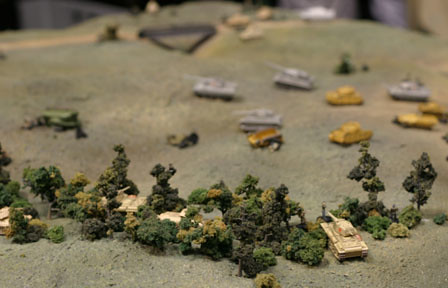 I’ve got a big pile of WWII minis laying around from the year or two I spent actively playing Avalon Hill’s Axis & Allies Miniatures game. This isn’t the huge-ass board game that takes hours to set up and many more hours to play; I’m talking about the collectible tabletop wargame that came out in the fall of 2005 and (to my knowledge) remains a supported product to this day.
Alas, Axis & Allies Miniatures had a fairly short life for me. The rules were somewhat dumbed-down (Avalon Hill is just another Hasbro brand, just like Wizards of the Coast) and each new release added increasingly goofy mechanics to the game. Plus it was collectible, meaning there was always something new to buy.
I’m proud to say I was part of the Historic House Rules (HHR) initiative that helped inject a little realism back into the game. Together with four other players (whom I never actually met in person; we just corresponded via the web) we gutted AAM’s rules and built a new framework from the basic structure of the game. I had a blast during those hectic months, discussing revisions on the Avalon Hill forums, editing PDF proofs and answering questions from enthusiastic gamers. I daresay the HHR rules improved AAM for a lot of people. (You can download the latest version of the rules from the good folks at Historic Battlefronts.) In an ironic twist, I never actually got to play the game with my own house rules; the one guy in Chicago I knew who played regularly turned up his nose at the HHR rules.
So I haven’t played the game since last summer, but I’ve still got piles of cool miniatures sitting around, all in more or less the same scale. And I love WWII tabletop gaming, owing in large part to my ongoing passion with WWII, particularly the Eastern Front. So I’m determined to find a cool set of rules to use with my minis — hopefully one that does away with AAM’s horrid hex maps. I’ve found a few free games and a few for-sale rulesets that look promising, and I’m actively on the lookout for more candidates. For now, I’m not looking to spend much more money — Crossfire’s $20 rulebook is about the limit of my budget and interest. But I dearly want an excuse to dust off my T-34s and take to the battlefield once again.
Monday, August 25, 2008
Rock-Con 2008 is on my calendar
Gencon was fun — but huge. I only ended up playing one scheduled game, although in all fairness we were able to snag a few demos and sit-down board games.
I’m excited about Rock-Con, a medium-sized annual convention outside Rockford, IL. That’s about an hour from my place in Chicago, so this is an ideal convention for someone (like me) who wants to actually play games, rather than shop and watch others play games.
There’s very little content on the Rock-Con 2008 site right now, and I really hope that changes soon. I’m particularly excited about the historical minis representation at the con — it’s put on by the Noble Miniatures team, so you can bet they’ll have a bevy of historical wargames on hand. For a guy who’s been spending a lot of time with sci-fi and horror RPGs, there’s something really appealing about taking command of a Wehrmacht detachment in the ruins of Stalingrad. Count me in.
I’m excited about Rock-Con, a medium-sized annual convention outside Rockford, IL. That’s about an hour from my place in Chicago, so this is an ideal convention for someone (like me) who wants to actually play games, rather than shop and watch others play games.
There’s very little content on the Rock-Con 2008 site right now, and I really hope that changes soon. I’m particularly excited about the historical minis representation at the con — it’s put on by the Noble Miniatures team, so you can bet they’ll have a bevy of historical wargames on hand. For a guy who’s been spending a lot of time with sci-fi and horror RPGs, there’s something really appealing about taking command of a Wehrmacht detachment in the ruins of Stalingrad. Count me in.
Subscribe to:
Posts (Atom)
